| Geisha Exhibition |
|
|
Origins of the Name Given to the Pleasure Quarter ‘Yoshiwara’
|
‘Yoshiwara’
 |
What eventually became a place of pleasure and luxury, was built upon a field of rushes. It is argued that it is the two characters (yoshi = rush grass) and (wara = field) that was the origins to the name of ‘Yoshiwara'. Eventually the character for Yoshi, was given an alternative kanji character with an auspicious meaning (but read the same way) and hence came to be written as in a way which translates as ‘Field of Good Fortune'.
|
|
Origins of Yoshiwara
|
|
| |
Shogun Tokugawa Ieyasu came to Edo (present Tokyo) in 1590 and established Edo bakufu (Japan's feudal government) in 1603 after the victory of the Battle of Sekigahara in 1600. The city of Edo prospered and became the capital of samurai warriors. An immediate implementation of the city's infrastructure was required, as he had led many of his feudatories with him from Mikawa where he had reigned before Edo. Many men who had lost their jobs after the war gathered to Edo for business (according to a record from 1733, residents of the city were 540,000 of which 340,000, 63% of them, were male). However this did not take into account the 500,000 odd samurai warriors based in Edo (who had left their wives in their home town) partly due to the Sankin Koutai policy. Thus the proportion of man to woman in Edo being four to one, there was a saying "eight grooms for one girl". For this reason, the pleasure quarter was perhaps a necessity in the city of Edo.
|
|
To enhance the functioning and infrastructure of the capital that now ruled Japan, and with its rapid development, to make way, people were commonly forced to move to other places - especially brothels were continually forced to move. Troubled by the many eviction orders, the brothels petitioned the bakufu that a pleasure quarter should be established. The government ignored them at first, however, after several petitions, Shoji Jin'emon, representative of bordellos, pointed out firstly, that Edo would be the nest of criminal if bakufu had let bordellos go unchecked, and secondly, that although there were 20 pleasure quarter in Japan, none of these existed in Edo.
His petition in 1612, requested the granting of a licensed pleasure quarter with the following restrictions.
To only allow customers to stay for one night - thus preventing men from neglecting family duties.
To investigate any girl that may have been deceived into working at the pleasure house so as to prevent any unlawful kidnapping of girls from good families.
To report any suspected criminals and fugitives who may use the pleasure quarter hideouts.
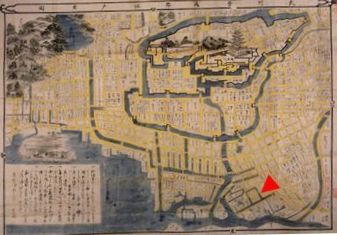
Five year later, with the petition accepted (1617), operators were granted a vast swamp land not far from Edo castle in the city centre along Edo bay. The government however demanded further conditions - that no bordello would be permitted to establish within Edo city, no courtesans should be sent for call outs within Edo, brothels and the clothing of courtesans should be modest and that business hours to be limited to daytime only. With the restriction of opening hours, most customers were samurais with idle time, as it was not convenient for merchants to visit Yoshiwara during the day.
|
Structure of Yoshiwara
|
|
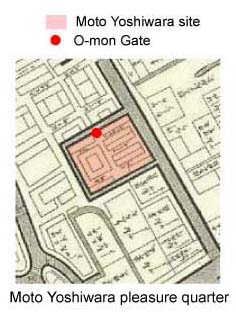
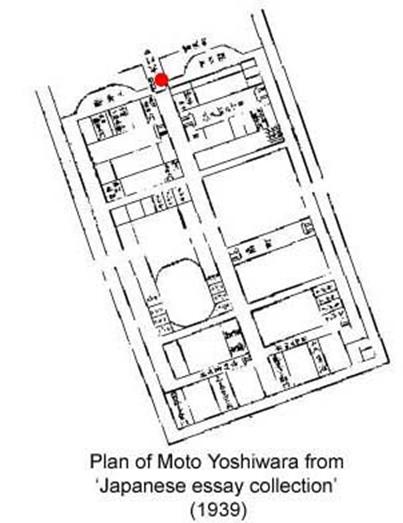
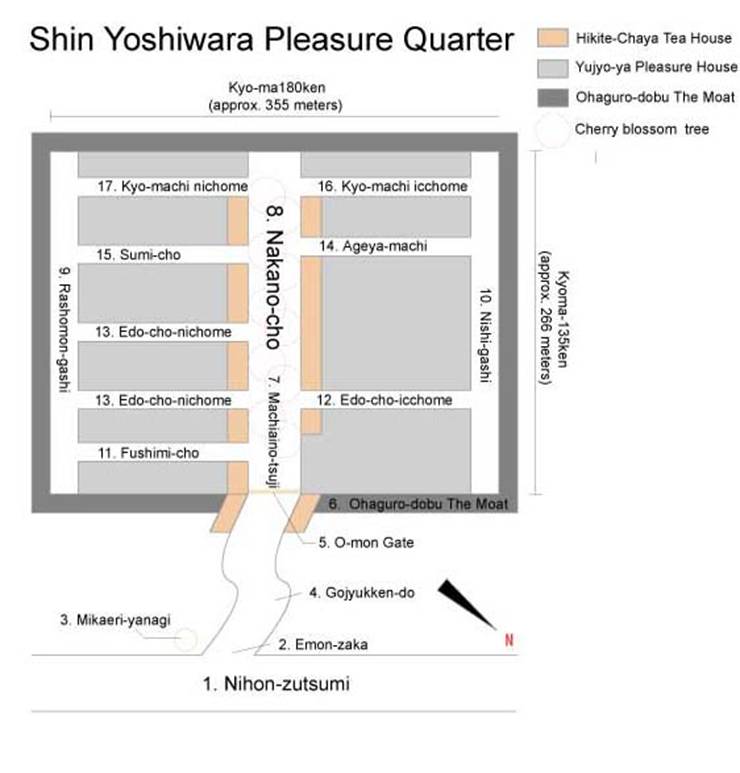
Jin'emon built the Yoshiwara area surrounded by a wall of which one side had a river adjacent to the quarter. With only one entrance, the O-mon ‘Great Gate' (positioned on the north side), and furthermore surrounded by a moat, he ensured security and avoidance of escape by the girls of the pleasure quarter.
|
The total size of the area measured approximately 4.8ha (approximately 220m x 220m) and was divided into blocks with the following names: Edo-cho-icchome , Edo-cho-nichome, Kyomachi-icchome, Kyomachi-nichome and two years after the establishment of Yoshiwara, the fifth block of Sumimachi was added. The first block to the right as one entered the Great Gate. This block was comprised of pleasure houses belonging to Jin'emon and in fact became the most prestigious block of the pleasure quarter.
|
|
|
Shin-Yoshiwara (New-Yoshiwara) |
| |
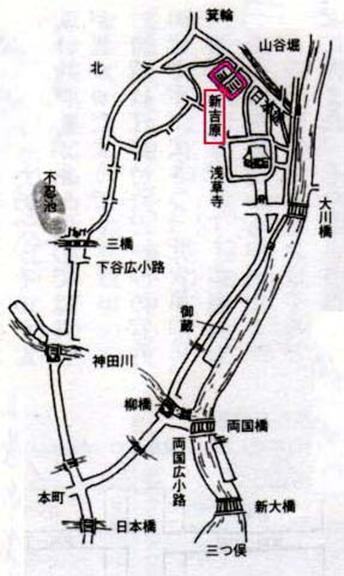
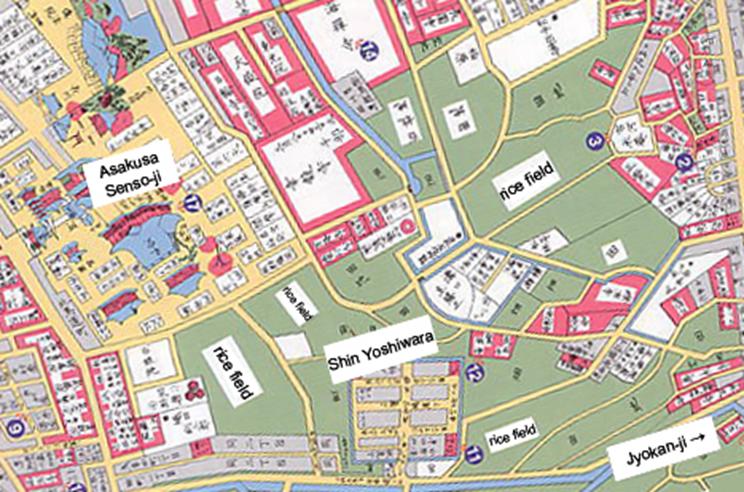
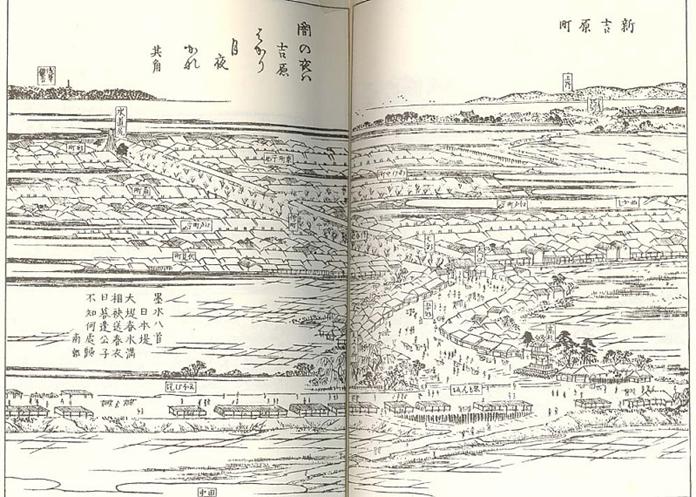
Edo city centre continued to expand, to the extent that the daimyo (Japanese feudal lord)'s estate had built itself adjacent to the Yoshiwara pleasure quarter. Bakufu government not wishing the pleasure quarter being in the center of Edo and witnessing the young samurai addicted to meeting courtesans, in 1656 commanded the quarter to be transferred to the suburb along Nihon-zustumi behind Sensou temple (present Asakusa and Senjyu district). Yoshiwara proprietors were shocked as they had presumed they owned the land upon which their businesses were built by their fathers and grandfathers. As a compensation of the move to a more remote part of Edo , the government offered a land 1.5 times in comparison, as well as 15,000 ryo in money for the moving expense. A license was also granted for operating business at night.
|
|
|
The transferred Yohiwara was referred to as Shin-Yoshiwara (New-Yoshiwara ) and the previous Yohiwara was then referred as Moto-Yohiwara ( Original-Yoshiwara ). Though soon after, Shi-Yoshiwara became to be called simply as Yoshiwara . In the three hundred forty year history of Yoshiwara , Moto-Yoshiwara existed only for the initial forty years.
anuary of the following year (1657), Edo was damaged by Meireki Fire, which burnt down not only Edo castle but almost the entire city, and victims numbered more than 100,000. Although the transfer was delayed by the fire, all the bordello which had lost their shops and those who had continued running business at temporary locations, finally moved to Shin-Yoshiwara by June 1657. |
Golden Age of Yoshiwara |
|
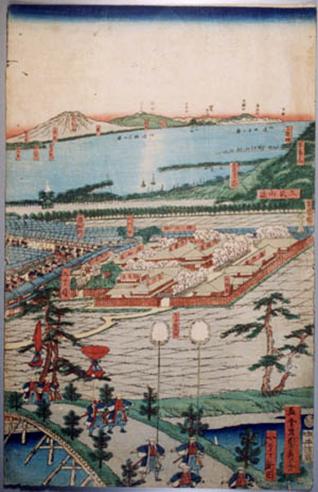
initially after the move, business was desolate. Far from the city centre, surrounded by rice fields, the buildings with the uneven floors and irregular eaves that were hastily built - it simply added to the unattractiveness of the new pleasure quarter. |
|
However, with the economic growth of the late 17 th C, the Yoshiwara underwent a revival and reached its golden age. Business now licensed to run at night-time, merchants took the place of samurai. According to Yoshiwara-saiken , the guide book of the Yoshiwara , the number of courtesans increased from 2552 in the year of 1656, to a dramatic increase to 7197 courtesans by the year of 1846. |

|
| End of Yoshiwara |
Yoshiwara continued receiving its license even after the collapse of the Edo government and into the Meiji period (1868 – 1912). By the time the law against prostitution was enforced in 1957, the Yoshiwara pleasure quarter from the origins of the Moto-Yoshiwara era, had lasted for a total of 340 years. |
 |
|
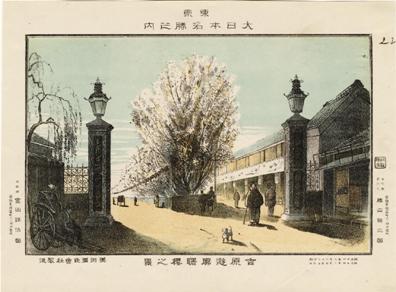
1. Nihon-zutsumi The way to Yoshiwara. 2. Emon-zaka The name is derived from the custom that customers would fix their ‘ Emon ' (collar of traditional kimono), prior to entering the Yoshiwara quarter . Hence ‘zaka ' meaning ‘hill', the name ‘ Emonzaka ' would literally translate as the ‘Hill of Emon Collar'. |
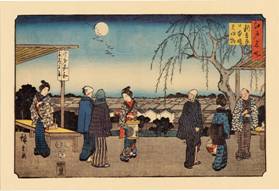
3 . Mikaeri-yanagi Willow trees ( Yanagi ) outside the Yoshiwara district, that looked like courtesans waving in farewell with regret when looking back ( Mikaeri ) after visiting Yoshiwara .
Those willow trees after some generation still exist today. |
|
4. Gojyukken-do From the road of Nihon zutsumi the path leading up to the O-mon Gate was approximately ‘Gojyukken '(approximately 90M) – hence the name ‘ Gojyukken-do' (translates as the path of Gojyukken ). This path was curved in two areas so as not to see the O-mon gate from Nihon-Zustumi – perhaps to allow more discretion for the visitors to the pleasure quarter.
5. O-mon Gate O-mon Gate was the only gate to enter the Yoshiwara district, in order to prevent thieves from breaking into Yoshiwara and also to prevent the courtesans from escaping.
6. Ohaguro-dobu There was a moat filled with water, approximately nine meters wide, surrounding Yoshiwara to prevent thieves breaking into Yoshiwara and to prevent courtesans from escaping. The name is derived from the fact that courtesans would clean off their ‘ Ohaguro ', black color cosmetic to paint their teeth, which made the water cloudy and black.
7. Machiai-no-tsuji Requested upper-class courtesans used this point as a ‘ Machiai ' rendezvous point with their clients.
8. Nakano-cho Nakano-cho was the main street in Yoshiwara , along which were many of the Cha-ya (or Hikite-Cha-ya ).
9. Rashomon-gashi This name comes from lowest-ranking courtesans, whose inns were located on this street. The courtesans said to not letting go of their customer's hand like a demon in ‘ Rashomon ' - hence the name ‘ Rashomongashi' (translates as ‘Riverbank of Rashomon ').
10. Nishi-gashi This district contained the same ranking inns but a slightly better status in comparison to Rashomon-gashi . |
Structure of the Pleasure Houses
|
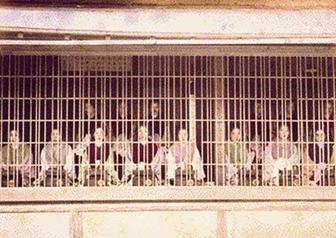
Figure 1 |
|
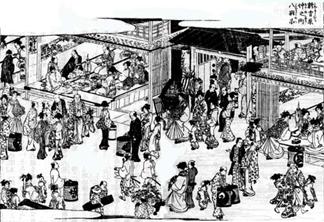
| Along the roads running off the main Nakano-cho road, there would be pleasure house's with their display of Hari-mise - where courtesans, |
| would sit and wait for customers behind the lattice façade of the house to allow the customers to see inside. The highest ranking courtesans, however, were not part of this harimise display .
The rank of a pleasure house was distinguished by these grids - High-class pleasure houses were referred to as Sou-magaki (translates as ‘whole grid') Figure 1 & 2, middle-class were referred to as Han-magaki (translates as ‘half grid') Figure 3, and low-class housese were referred to as Sou-han-magaki (translates as ‘whole half grid) Figure 3. |
|
Courtesans would line up according to their rank. The high rank courtesan would sit in middle with the Tabako-bon (a compact unit containing a complete set of smoking equipment and ashtray). If a customer |

|
approached the grid who had been a previous customer, the courtesan would prepare and hand a pipe to him and converse to allure him. Other courtesans would sit in the order of ranking, and among the same rank they sit in order of their monthly earnings.
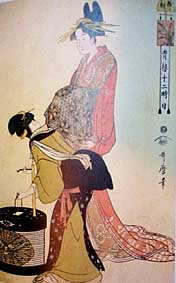
After lights were set up in the district (from around five to six o'clock in evening), wakaimon (young male staff) of the pleasure house, would hit the pillar three times and courtesans (mainly the female sinzo attendants) would start to play the Shamisen musical instrument.
Besides for the above purpose, the ground floor also had an area used for the people of the house, including the owner's room, kitchen, bathroom and restroom. Customers would enter the house from the entrance on the side of the Hari - mise and would be guided to the main stairs on the side of the ground floor to go upstairs. |
|
First floor – the rooms of pleasure entertainment |
 |
|
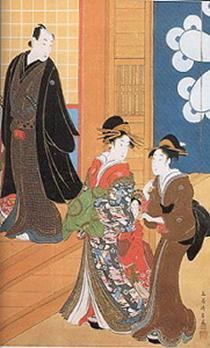
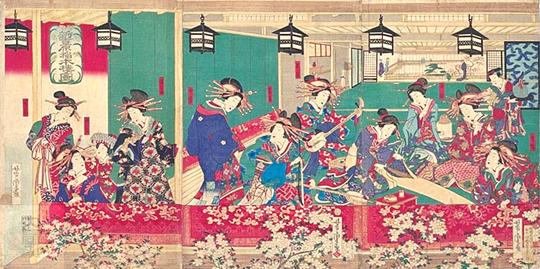
The rooms on the first floor would be divided into many small rooms such as Hikituke-zashiki where customers would first be taken to negotiate their fees with Yarite (Figure 5) and have a dinner. This dining and entertainment took place in the first floor either in the room that belonged to the courtesan of their choice (in the case of popular courtesans) or a general entertainment room (for courtesan those who didn't have their rooms). Some popular courtesans would have many of their own rooms which they bought from their owners. Courtesans who had their room were regarded as full-fledged courtesans. |
Oiran-dochu
|
|
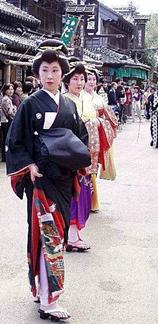
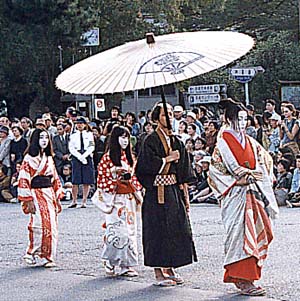
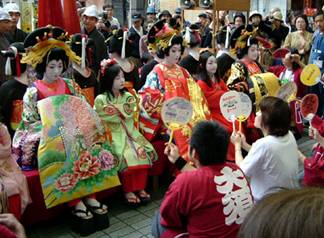
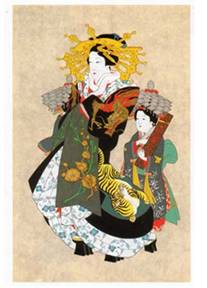
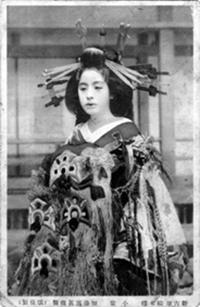
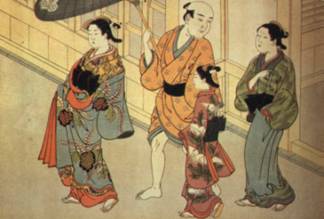
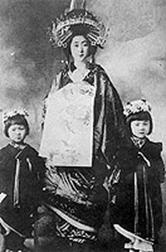
One of the great spectacles of Yoshiwara even reenacted today, is the Oiran-dochu .(literally translating as ‘Courtesan in the Street' or ‘Travelling Courtesan'). Taking their Shinzo and Kamuro female servants and apprentices along with them, Courtesans dressed up in magnificent costumes and paraded slowly in the traditional manner known as hachimonji (where the knees are kept adjacent to one another whilst walking.) |
There were two types of Oiran-dochu . One was similar to that which takes place for tourists today, which is a relic of a Tayu high class courtesan's elaborate entrance when making way to meet her client after a booking. A majestic display, accompanied also by the wakaimono (male assistant), yarite (negotiating manager) and male geisha along with them. After the extinction of the ageya system that required the parade
|
|
|
extinction of the ageya system that required the parade from her residence to the ageya to meet her client, this event then only took place for annual events such as New year, cherry blossom-viewings, announcements of a new Shinzo (female apprentice) – in essence, an event simply to attract and advertise Yoshiwara.
With the replacement of the ageya and the introduction of the chaya tea houses, |
dochu ‘parade' became less extravagant. Requested courtesans went to meet their customers at the chaya similar to when they visited the ageya – however, it was if a much smaller scale, with only their Shinzo and Kamuro girl servants - however, it was still magnificent enough to be attract visitors and sightseers. One could even say that this parade of Oiran Dochu , was in fact one of the best representations of the existence of the Yoshiwara pleasure quarter - the essence of the pleasure and flamboyance was shown off with pride and perhaps arrogance. The make the customer wait whilst the courtesan took time to display her grandeur – a power game of which this was just one example to create the idealised world of perfect pleasure. |
The process of receiving the service of courtesans |
Since the establishment of Yoshiwara , and up until 1760, to be entertained by the upper ranking courtesans such as ‘ Tayu ' and ‘ Ko-shi ', customers had to go to an ‘ Ageya ' - an inn which did not own courtesans but rather was an establishment for holding banquets for the Yoshiwara customers to which entertainment girls would be invited, amongst whom the visitors would chose and request their service. The customers would then be taken to a room and waited for the requested girl. The services of the pleasure quarters, from the intimate service, to sleeping, everything took place at the Ageya. |
|
In the case of popular Tayu (upper ranking courtesan), it was almost impossible to make an appointment the same day. Reservations with booking fee several days in advance were needed. |
Once a courtesan was requested at the Ageya , one of their staff would go to the Okiya (courtesan's dormitory) with a letter called ‘ Sashigami ' to inform them of the booking.
This ‘ Sashigami ' was commission letter from Ageya to Okiya , the contents of which would be something similar to the following:
“We have a customer at our establishment this day. He has placed a request for one of your people named [name of courtesan] to be entertained during the day. It can be confirmed that this individual is not a suspect of any kind and is identified as trustworthy. With best regards.” |
|
Once receiving the letter, the requested courtesan then in full attire, would parade and walk slowly in silent grandeur to the Ageya –this act was called ‘ Oiran-dochu '. It is said that whenever a Tayu was called, plenty of onlookers came to have the rare sight of her beauty, her grace and splendor of her kimono.
This letter was formality that was required as a result of ordinances imposed by the shogunate when the Yoshiwara pleasure quarter was established. It was very troublesome as each customer needed a Sashigami for every order. Ageya system seemed to be the culture of the pleasure quarter itself, however, its structure was shrouded with formality and perplexity. Ageya was very expensive not only for the payment for courtesans but also for the gratuity for the staffs and attendants of courtesans, banquet charge and commission. In the golden age between 1681- 1687, there were more than twenty Ageya in Yoshiwara .
Therefore, after the transfer to Shin Yoshiwara , ‘ Hikite-Chaya ' began to take the place of Ageya . Hikite-Chaya took an intermediary role, guiding the visitors to the Ageya , and then calling the courtesans standing by at the Okiya . Customers would wait for the courtesans watching the performance of Geisha or Hokan (man drum performer) . Hikite-Chaya flourished among the exclusive pleasure houses and they offered advantages to the Yoshiwara customers - such as offering flexibility of the entertainment location, the costs for the evening could be settled in one payment, whilst organising all the arrangements for courtesans. However, Hikite-Chaya gradually began to skip the Ageya and took their customers directly to the Okiya (in order to avoid the margin taken by the Ageya ) and consequently, Ageya began to face a decline whilst Hikite-Chaya thrived increasingly. The last Ageya closed in 1761. From then onwards, instead of tayu or koshi , the upper class courtesans were simply referred to as Oiran.
During this period, many relatively less-expensive classes of prostitutes had gained popularity. With transfer of Yoshiwara , Government arrested approximately two hundred illegal brothels within Edo many of which were bathing houses. However, regardless of the regulation of illegal prostitution, new bath houses were continually built, and their illicit service threatened the Yoshiwara business. The puzzled magistrate's office set the negotiation between Yoshiwara prospector and bath house representative. As a result, 71 owners of bath houses with 512 prostitutes moved to the Yoshiwara quarter and placed in the Fushimi-cho and Sakae-machi areas within Edo-cho-nichome . Those prostitutes were referred to as Sancha courtesans. Even daimyo or wealthy merchants had to act within the guidelines and personal requests or rejections imposed by the standard courtesans of Yoshiwara , whist having to go through the expensive process of the Ageya houses to receive courtesans. In contrast, Sancha courtesans were cheap – uneducated and without the training of the usual Yoshiwara courtesans, they did not have the pride or impose the formality and allowed a more affordable relaxed informal manner of entertainment. Though despised by the original courtesans, they prospered rapidly while high class courtesans such as tayu and koshi declined. The new Sancha prostitutes, however in time, were also then gradually divided into various ranks.
Inns were divided into these 3 classes, O-mise (upper-class), Naka-mise (middle-class), Ko-mise (lower-class). Whereas Hikite-Chaya 's mediations were needed to use O-mise , it was possible to use other inns without the introduction through Hikite-Chaya – this was referred to as ‘ Suagari '. In either case, whether using Hikite-Chaya or by means of Suagari , samurais had to deposit their swords to the inns: a measure that was to safeguard any severe injuries as a result of possible drunken fights at the inns.
Many men visited Yoshiwara , but they were not automatically and immediately given the chance to sleep with their chosen courtesan especially of a higher rank as there was a variety of ‘playing' rules. As a ground rule, women had precedence – one of the rare areas of traditional Japan where the female held the upper hand. Even the feudal lords or merchant princes had to abide by these rules. An initial necessity was the introductory formality of ‘ Kaomise ' (literally translating as ‘Showing of the Face').
The customer was required to make a payment of 300 ryo to the pleasure house, and was then asked to wait. Without speaking, in impeccable attire the courtesan would make an appearance and be seated in front of the client. Introduced by the yarite (negotiator of the house) a drinking formality would take place with a sake cup which often involved simply pretending to drink sake. The privilege of the upper ranking courtesans was at this point to enable the rejection of a client by politely refusing to take the sake cup.
If accepted, they would go to bed, however, just to lie down together and, after which, a few minutes later, the courtesan would leave the room. The first visit also referred to as ‘ Sho-kai' (translates as ‘first meeting') , the second meeting is referred as ‘ Ura ' (translates as ‘reverse', which is still exist as a prostitute slang today. At the second meeting, the customer would have a conversation and the courtesan would be more convivial than first time, albeit, he still would not be allowed to make love with her. He would then have to return approximately three times and on each occasion make a gift equating to approximately 300 ryo for which unless the courtesan was satisfied, he would not be granted to receive the intimate service. If a customer was enraged upon a refusal, an ‘ oniwaban ' security guard would escort him out.
From the third visit, the customer would be treated as ‘a familiar customer' and special chopsticks and chopsticks case would be provided for him. He also had to give a ‘ Toko-hana' , a tip, which a customer gave to the courtesan on the bed as a proof of being ‘a familiar customer'. In any case, the formal Yoshiwara had a clever system which was set up to require a customer to continually pay in order to be entertained. To ensure continual business, another regulation was such that, upon succeeding in receiving the full entertainment of a courtesan, the customer was prohibited from betraying and using the service of another courtesan – if such cases arose and discovered a severe penalty was imposed. The offender was then called an Uwaki-kyaku (Flirting Customer), and forced to wear a long-sleeved kimono and their hair cut in front of all the staff of the Ageya as well as having to pay a very heavy fine. |
Annual Events of Yoshiwara
|
Events held in Yoshiwara , were almost identical to general annual events carried out generally across Japan , however, there were some events exclusive to Yoshiwara . These events were of flamboyance and of magnificence, as the identity of Yoshiwara was that of pride, enticing and astonishing into a world of fantasy. The events required a lot of financing. Women who were not related to the courtesans were also permitted to join in some of the events. Those special days were referred to as Monbi . On these days, despite the fees of courtesans were doubled, they were obliged to take clients in order to cover the extravagant cost on the festivities. Even though the people were enjoying themselves, it was a day that the courtesans could not relax and enjoy but instead searched to make sure they managed a booking. After kyoho era, those events would increase for the purpose of attracting further customers from Edo . |
|
There were three big events in Yoshiwara , Cherry blossom-viewing in the Spring, Tamagiku lantern in July and Niwaka festival in August.
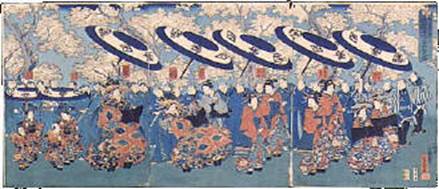
Cherry blossom trees, with the roots intact, would be carried to the main street and planted along Nakano-cho in the middle of February so that cherry blossoms could bloom on Monbi in March. It would be removed when the bloom fell. Tea houses would hang lanterns for the night view of cherry blossom.
Tamagiku lantern festival was held during July. Tamagiku was the name of a courtesan during the Sho-toku period (1711 – 1716) and died young. This festival started as her eulogy. From the first of July, tea houses along Nakano-cho would hang the same lantern under eaves. The lanterns were then removed on the twelfth. Then from the sixteenth, until end of the month, each tea house hung different elaborate lanterns under their eaves to celebrate this festival – a true visual spectacle when visiting the pleasure district at night.
The first of August would be referred to as hassaku , a day to celebrate the day that shogun Tokugawa Ieyasu entered Edo castle. Feudal daimyo lords of the Edo castle visited Edo castle annually wearing white single robed kimonos – and thus similarly, the festival in Yoshiwara took place also in Yoshiwara wearing plain white kimonos on the first of August. Niwaka festival also took place on the same day and throughout the month of August. |
| Nikawa was a festivity with amateur performers entertaining vaudevilles within banquet rooms and outside on the streets. This later developed into seated staged performances. Courtesans and taikomochi (literally translating as ‘holding drum' also referred to as male geisha)male assistants of courtesans, would show off their various performances on top of elaborate dance cart that was wheeled around the Yoshiwara pleasure district during the festival . |
|
A day of a Courtesan
Daily Schedule – Western hours equated in Summer and Winter Time |
05:00
07:00 |
Open the ‘ O-mon ' Gate
The courtesans who, after seeing off the guests who stayed the previous night, would sleep again. It appeared that it was a custom for guests who stayed the night, would eat breakfast such as rice porridge at the ‘Cha-ya' or ‘ Nakayado' on their way home.
Important customers were seen off to the O-mon Gate by the courtesans. |
07:20
08:40 |
Starting work
People who did business with Yoshiwara , (eg.needlworkers) would arrive. |
09:40
10:20 |
The hour of rising for courtesans
It appeared that vendors worked busily around this time.
The cleaning of the inns and arranging of flowers took place at this hour.
|
12:00
14:20
|
Starting of the afternoon show time
Before the opening time, courtesans would take a bath, dress their hair and do their faces. Since it was not so busy during the afternoon showtime, courtesans spent their time leisurely to write letters or to read books. |
16:40
15:20 |
Close afternoon show time
Before the evening show time, courtesans would have dinner. |
19:00
17:00 |
Open evening show time
Just before the evening show time, around the time when lights were lit for the evening, the ‘ Dochu ' ceremony of courtesans parading the street would take place. Courtesans would also start ‘ Hari-mise ', the introduction to show themselves to the customers, with ‘ misesu-gagaki ' music announcement.
|
20:40
19:20 |
Going to bed
After a huge banquet, customers and courtesans went to bed. |
22:20
21:40 |
Closing of the ‘ O-mon ' Gate
This hour was called ‘ Kaneyotsu '.
After closing the O-mon , people used a wicket gate next to the O-mon . |
24:00
24:00 |
Hike-yotsu
Inns would close their shutters and people used the wicket gate instead.
A fire warden would go around ringing metal rods to remind people to put out any fires. |
01:40
02:20 |
O-hike
All courtesans, those who were with customers as well as those who did not work that day, would go to bed. |
03:20
04:40 |
Kinuginu
The parting of customers from the courtesans was referred as ‘ Kinuginu '.
Shop staffs from the Cha-ya tea house would come to meet customers who stayed at the inn. It appeared that cleaners from imprisoned quarters called ‘ hinin-tame ' came to clean the inns around this time. |
The Life of Entertainment Girls |
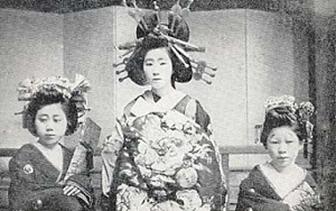
The beauties of the pleasure quarter of Yoshiwara were often purchased from poor families by zegen – a human trafficking broker who would trade girls, often of a young age, to establishments enforced to work in the pleasure quarters. Courtesans often started off from a young age belonging to a pleasure house, and brought up as kamuro (girl servant) . Despite this, the government had forbidden trading of human beings. Therefore, in theory, it was regarded as a ten year indenture where they worked for the house as their servant. The girls were not allowed to step out freely from the house like a caged bird. The pleasure quarters was referred to as ‘kugai' (distressful world) by the girls, and being sold to Yoshiwara was termed ‘Drowning the self (body) into the distressful world'
|
|
In addition to the heavy work, most courtesans would have abstemious meals and their living hours would be liable to be irregularity.
By profession, probability of venereal was very high and many courtesans would catch incurable diseases. Some pleasure houses had retreats outside Yoshiwara , however, it appeared that less than one percentage of them would return from a retreat to work again. Through torture, or at times suicide for forbidden love affairs, majority of courtesans died young. According to the death registry, majority of courtesan died in their early twenties – considerably shorter than the average life expectancy even of the period. As most girls died prior to completing their ten year period, the luxurious image of the floating world of Yoshiwara , behind the scenes, was referred to as ‘the hell of the floating world'. |
|
|
After 10 years of apprenticeship, finally, courtesans technically were free. They would then either establish a household with the person they loved, or remained in their pleasure house as a yarite (sales manager of the house) or continued prostituting either in low rank pleasure houses or in okabasho , illegal pleasure house. However, reality was that many of them were forced to remain working to pay their debts. Both courtesans who had been sold to Yoshiwara as well as those who were brought up as kamuro servants, incurred huge debts for the initial outlay. They then had to bear a load of debt to arrange their clothing and furniture. High earning courtesans had to support their attendants such as kamuro or shinzo as a result and this in turn meant the courtesans also were caught into this vicious circle of dept. Fortunate courtesans who found a wealthy lover, would have him pay off their dept in order to be freed. However, most of them had to remain working often for twenty years, simply to pay of their debt. |
To escape from Yoshiwara , there were only two choices. One was to get over the moat after O-hike when the people of Yoshiwara had gone to bed (one or two o'clock at night). Another was to escape through the O-mon gate during its opening hours. It is said that some courtesans tactfully dressing as man could cheat the guards and escape through the O-mon gate just before O-hike aided by the darkness. In many cases, courtesans would be helped by their close customers to escape together risking their lives. When Yoshiwara found they were escaping, pursuers such as wakaimono , male servants of pleasure house, and commissioned gangsters would fan out all directions to capture them. When seized, the man would be tortured and the woman tied with her hands behind her back, forced back to Yoshiwara and punished accordingly . |
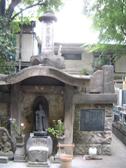
Jyokan-ji (throw-in temple) Jyokan-ji , a temple of Jodo shu – its name literally translates as ‘throw-in temple', deriving since the great earthquake of 1855 that killed many of the courtesans, instead of a funeral, were simply thrown in to a large hole. Many, at the point of death, with no relatives to take care of them, did not receive a formal funeral – it is said that the number of buried courtesans are approximately twenty thousand.
A memorial tower was built with a stone monument with a carved with the inscription.
‘Born in a distressful world, death in Jyokan-ji temple' ' |
|
|
|
|
|